# Reconcile Group Payments (/docs/guides/group-payment/group-payment-reconcilation)
# 📊 Reconcile a Group Payment Session [#-reconcile-a-group-payment-session]
When multiple customers contribute to a group payment, each payment is tracked individually. To support reconciliation, Hands In provides a `referenceId` that can be used to identify and trace payments across systems.
By default, any `payment` made under a group payment session will have a `referenceId` formatted as:
```
{groupPaymentId}_{customerId}
```
Where:
* `groupPaymentId` is the unique ID of the group payment session.
* `customerId` associated with the participant in the group who the payment is for.
## 🧾 Using `referenceId` for Group Payments [#-using-referenceid-for-group-payments]
When creating a group payment session, you may pass a custom `referenceId`. This value will be prefixed to all payment `referenceId`s for a particular group order, allowing you to easily match incoming payments with your system records.
### Example Create Request with `referenceId` [#example-create-request-with-referenceid]
```bash
curl --request POST \
--url https://api.sandbox.handsin.com/v1/group-payments \
--header "Accept: application/json" \
--header "Content-Type: application/json" \
--header "x-api-key: " \
--data '{
"idempotencyKey": "example_unique_idempotency_key",
"referenceId": "YOUR_UNIQUE_MERCHANT_ORDER_REF",
"amountMoney": {
"amount": 2000,
"currency": "GBP"
},
"customer": {
"firstName": "Example",
"email": "example@handsin.com"
},
"lineItemParams": [
{
"item": {
"name": "Example LineItem",
"amountMoney": {
"amount": 1000,
"currency": "GBP"
}
},
"quantity": 2
}
],
"splitType": "BY_ITEM"
}'
```
```javascript
const url = "https://api.sandbox.handsin.com/v1/group-payments";
const payload = {
idempotencyKey: "example_unique_idempotency_key",
referenceId: "YOUR_UNIQUE_MERCHANT_ORDER_REF",
amountMoney: {
amount: 2000,
currency: "GBP",
},
customer: {
firstName: "Example",
email: "example@handsin.com",
},
lineItemParams: [
{
item: {
name: "Example LineItem",
amountMoney: {
amount: 1000,
currency: "GBP",
},
},
quantity: 2,
},
],
splitType: "BY_ITEM",
};
try {
const response = await fetch(url, {
method: "POST",
headers: {
Accept: "application/json",
"Content-Type": "application/json",
"x-api-key": "",
},
body: JSON.stringify(payload),
});
const data = await response.json();
console.log(data);
} catch (error) {
console.error("Request failed:", error.message);
}
```
```python
import requests
url = "https://api.sandbox.handsin.com/v1/group-payments"
headers = {
"Accept": "application/json",
"Content-Type": "application/json",
"x-api-key": ""
}
payload = {
"idempotencyKey": "example_unique_idempotency_key",
"referenceId": "YOUR_UNIQUE_MERCHANT_ORDER_REF",
"amountMoney": {
"amount": 2000,
"currency": "GBP"
},
"customer": {
"firstName": "Example",
"email": "example@handsin.com"
},
"lineItemParams": [
{
"item": {
"name": "Example LineItem",
"amountMoney": {
"amount": 1000,
"currency": "GBP"
}
},
"quantity": 2
}
],
"splitType": "BY_ITEM"
}
response = requests.post(url, headers=headers, json=payload)
print(response.json())
```
Now any `payments` made into this group payment session will have the following `referenceId` - `YOUR_UNIQUE_MERCHANT_ORDER_REF_{customerId}`
where `YOUR_UNIQUE_MERCHANT_ORDER_REF` is the value you passed in to the `referenceId` field when creating the group payment
## 🔍 Look Up Payments Via Your Merchant Dashboard [#-look-up-payments-via-your-merchant-dashboard]
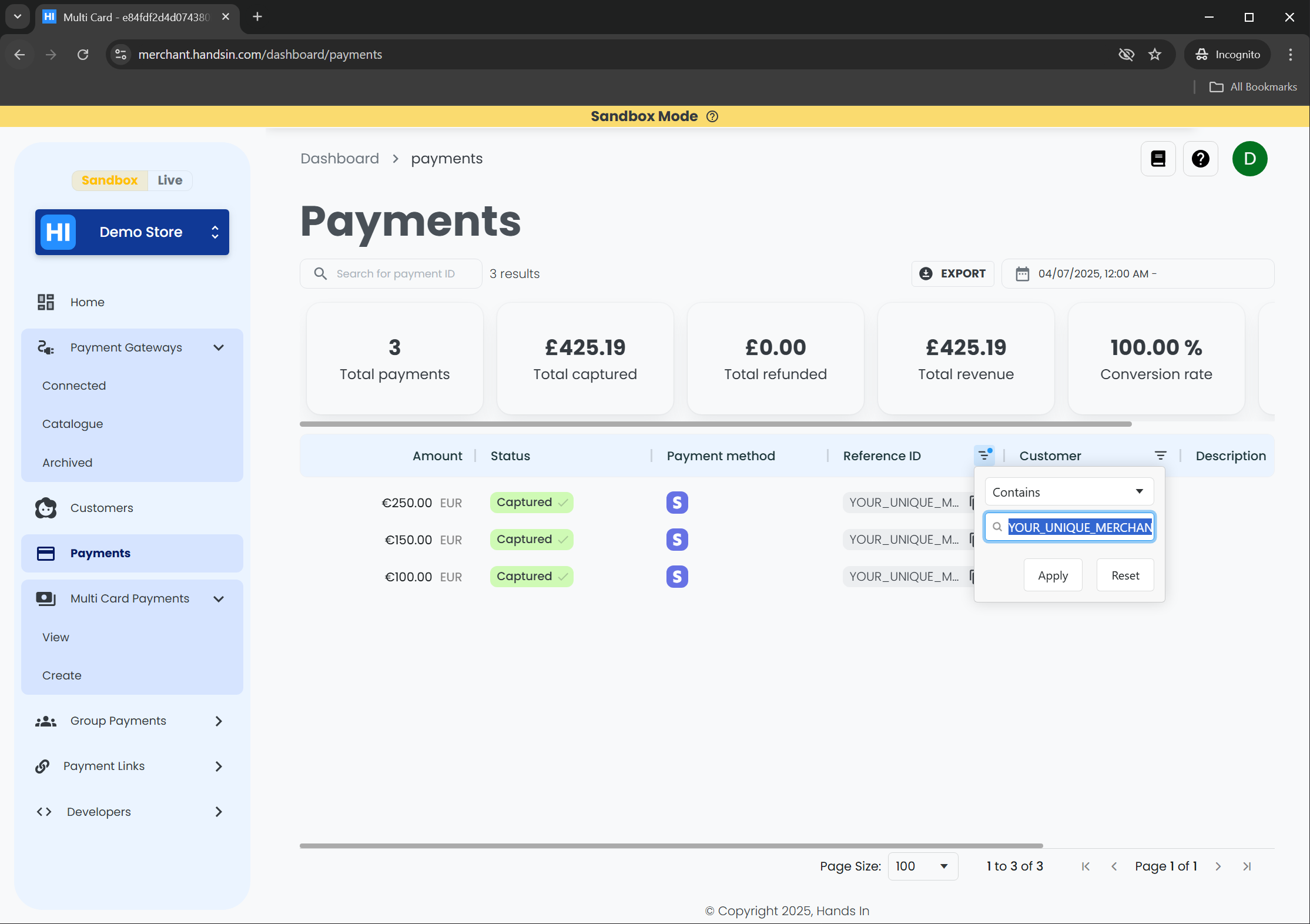
Using the table column 'reference Id' - You can search and filter your payments by your system's referenceId directly from your [Hands In Payments Dashboard](https://merchant.handsin.com/dashboard/payments)
In the example above, 3 payments out of many payments were found, with the following `referenceId`'s:
| Card # | Example Reference ID |
| ------ | ---------------------------------------------- |
| 1 | YOUR\_UNIQUE\_MERCHANT\_ORDER\_REF\_CUSTOMER-1 |
| 2 | YOUR\_UNIQUE\_MERCHANT\_ORDER\_REF\_CUSTOMER-2 |
| 3 | YOUR\_UNIQUE\_MERCHANT\_ORDER\_REF\_CUSTOMER-3 |
***
✅ That's it — you've learned how to use `referenceId` to help reconcile payments from a group payment session using your dashboard.
➡️ For real-time reconciliation and tracking of events, we recommend setting up [webhook notifications](/docs/guides/group-payment/group-payment-webhooks) to receive updates as they happen.\
Alternatively, API integrations can poll the group payment session and fetch each payment for that session using the values from the group payment's `memberPayments` field and in conjunction with the [retrieve payment endpoint](/docs/API/v1/getPayment)